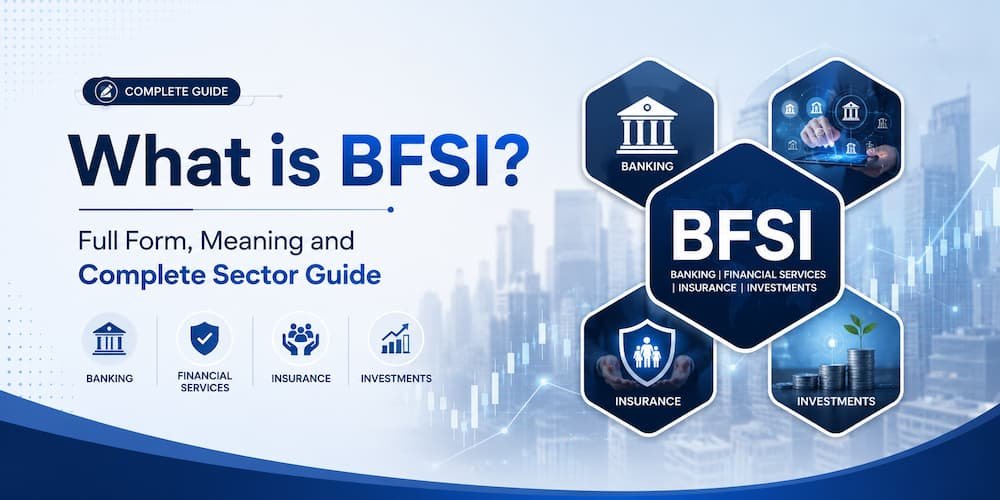
BFSI stands for Banking, Financial Services and Insurance. It describes India’s largest regulated industry, covering commercial banks, NBFCs, mutual funds, stock brokers, insurance companies and fintech platforms. As of 2024, the BFSI sector contributes approximately 6.5% to India’s GDP and employs over 5 million people directly across its three pillars.
Introduction
The BFSI sector is the backbone of India’s economy. Every time you use your UPI app, pay an EMI, renew your health insurance or invest in a mutual fund, you are interacting with what is BFSI in practice. Not a theory. Not a concept. A living system that processes trillions of rupees every single day.
Yet most people who work in this industry, study for BFSI jobs, or prepare for JAIIB and NISM certifications have never read a clear, complete answer to the question: what is BFSI, what does it actually cover and why does it matter?
This guide answers all of that. By the end, you will know the BFSI full form, what each pillar covers, which companies operate in this space, what BFSI jobs look like day-to-day, and how to build a career in the BFSI sector in India.
What is BFSI? The Full Form and Basic Meaning
BFSI stands for Banking, Financial Services and Insurance. The term is used across India and globally to describe the entire cluster of institutions, regulators and markets that manage money for individuals, businesses and governments.
The three letters represent three distinct but deeply interconnected industries:
• B — Banking: Commercial banks, cooperative banks, regional rural banks, payment banks, small finance banks and the Reserve Bank of India (RBI) which regulates them all.
• F — Financial Services: Everything that sits between banking and insurance. Non-Banking Financial Companies (NBFCs), mutual funds, stock brokers, portfolio management services, payment aggregators, account aggregators and fintech platforms.
• I — Insurance: Life insurance, health insurance, general insurance (motor, home, travel), and reinsurance companies. Regulated in India by the Insurance Regulatory and Development Authority of India (IRDAI).
The reason these three are grouped under one term is practical. In day-to-day business, they overlap constantly. A bank sells insurance products through bancassurance. A fintech platform offers mutual funds and loans on the same app. An NBFC uses insurance to secure its lending book. Understanding what is BFSI means understanding this interconnection, not just three separate definitions.
| Letter | Stands For | Regulated By | Examples in India |
| B | Banking | Reserve Bank of India (RBI) | SBI, HDFC Bank, ICICI Bank, Axis Bank |
| F | Financial Services | SEBI, RBI (NBFCs), PFRDA | Zerodha, Groww, Paytm Money, Bajaj Finance |
| I | Insurance | IRDAI | LIC, Star Health, HDFC ERGO, New India |
What is the BFSI Sector in India? Size and Scope
India’s BFSI sector is one of the fastest-growing in any major economy. The numbers are specific and they matter.
• India had 12 public sector banks, 21 private sector banks and 44 foreign banks operating as of March 2024 (RBI Annual Report 2024).
• The total assets of scheduled commercial banks crossed Rs 250 lakh crore in 2024.
• India’s mutual fund industry crossed Rs 54 lakh crore in AUM as of March 2024 (AMFI data).
• The insurance penetration in India stood at 4.2% of GDP in 2023, still well below the global average of 7%, meaning the growth runway is significant (IRDAI Annual Report 2023-24).
• India processed over 131 billion UPI transactions worth Rs 199.89 lakh crore in the financial year 2023-24 (NPCI data).
These are not abstract figures. They translate directly into jobs, career opportunities and business decisions. When you ask what is BFSI and why it matters, this is the answer: the sector is enormous, it is regulated by the most powerful financial authorities in India, and it is still growing.
From Our Research
One detail that rarely appears in BFSI explainers: the sector’s interdependence creates a career advantage that most freshers miss. A relationship manager at a private bank who can explain mutual funds, cross-sell insurance and process a home loan on a single customer visit is far more valuable than one who knows only banking products. The BFSI full form is not three separate careers. In practice, it is one ecosystem where cross-functional knowledge compounds your value every year.
What is BFSI in Banking? Understanding the Banking Pillar
Banking is the largest and most visible part of what is BFSI. In India, the banking sector is divided into several distinct categories:
Scheduled Commercial Banks
These are the institutions most people interact with daily. SBI, HDFC Bank, ICICI Bank, Kotak Mahindra Bank and Punjab National Bank are examples. They take deposits, lend money, process payments and offer a range of financial products.
Cooperative Banks and Regional Rural Banks
These serve smaller towns, agricultural communities and specific professional groups. Urban cooperative banks like Saraswat Bank have significant deposit bases. Regional Rural Banks (RRBs) are specifically mandated to serve rural India.
Small Finance Banks and Payment Banks
Newer categories introduced by the RBI. Small Finance Banks (AU Small Finance Bank, Equitas) serve the underbanked. Payment Banks (Paytm Payments Bank, India Post Payments Bank) can accept deposits but cannot lend directly.
When people ask what is BFSI in banking specifically, they are usually asking about the work done inside these institutions: credit underwriting, relationship management, branch operations, treasury, compliance, risk management and digital banking.
What is BFSI in Financial Services? The Widest Pillar
Financial Services is the most diverse part of the BFSI domain. It includes every institution that moves money but is not a bank and not an insurer.
Non-Banking Financial Companies (NBFCs)
NBFCs like Bajaj Finance, Muthoot Finance and Mahindra Finance lend money without holding a banking licence. They serve segments banks find difficult: gold loans, vehicle finance, microfinance, consumer durables. As of 2024, there were 9,400 registered NBFCs in India (RBI).
Mutual Funds and Asset Management
Fund houses like SBI Mutual Fund, HDFC AMC and Nippon India Mutual Fund pool investor money and deploy it across equity, debt and hybrid instruments. The industry’s Rs 54 lakh crore AUM is managed by 44 registered mutual fund houses (AMFI, 2024).
Stock Brokers and Capital Market Intermediaries
Zerodha, Angel One, HDFC Securities and similar platforms connect retail investors to stock exchanges. They are regulated by SEBI and form a critical part of the financial services ecosystem.
Fintech Platforms
Companies like PhonePe, Paytm, Groww and Razorpay sit at the intersection of technology and financial services. They are the fastest-growing segment within the BFSI domain, with India’s fintech sector valued at approximately $31 billion in 2024 (Invest India).
What is BFSI in Insurance? India’s Underpenetrated Opportunity
Insurance is the third pillar of BFSI and arguably the one with the most growth headroom in India.
• Life insurance covers risk to human life. LIC dominates with approximately 60% market share in new business premium, but private players like HDFC Life, SBI Life and ICICI Prudential are growing fast.
• Health insurance has seen its fastest growth since the COVID-19 pandemic. Standalone health insurers like Star Health and Niva Bupa have emerged as significant players.
• General insurance covers non-life risks: motor vehicles, property, travel, marine cargo. New India Assurance (public sector) and HDFC ERGO (private) are among the largest.
• Reinsurance is insurance for insurance companies. GIC Re is India’s sole domestic reinsurer.
The IRDAI had 58 insurance companies registered in India as of 2024. With insurance penetration at just 4.2% of GDP against a global average of 7%, the sector is structurally underserved. This makes insurance jobs and BFSI careers in this segment particularly resilient.
What are BFSI Companies in India? A Sector Map
Understanding what are BFSI companies requires looking across all three pillars. Below is a quick reference map of the major players in India’s BFSI sector.
| Category | Leading Companies | Regulator |
| Public Sector Banks | SBI, PNB, Bank of Baroda, Canara Bank | RBI |
| Private Sector Banks | HDFC Bank, ICICI Bank, Axis Bank, Kotak | RBI |
| NBFCs | Bajaj Finance, Muthoot, Mahindra Finance | RBI |
| Mutual Funds | SBI MF, HDFC AMC, Nippon, Mirae Asset | SEBI |
| Stock Brokers | Zerodha, Angel One, Groww, HDFC Securities | SEBI |
| Life Insurance | LIC, HDFC Life, SBI Life, ICICI Prudential | IRDAI |
| Health Insurance | Star Health, Niva Bupa, Care Health | IRDAI |
| General Insurance | New India, HDFC ERGO, Bajaj Allianz | IRDAI |
| Fintech / Payments | PhonePe, Paytm, Razorpay, BharatPe | RBI / SEBI |
What is BFSI Jobs? Roles, Salaries and Career Paths
If you searched for what is BFSI jobs or what is BFSI recruitment, you are probably at the start of your career or thinking about switching into the sector. This section gives you the practical picture.
Entry-Level BFSI Roles
• Relationship Manager (RM): Manages a portfolio of customers. Sells and cross-sells banking products, loans and insurance. Starting salary: Rs 3.5 to 5 lakh per annum.
• Credit Analyst: Reviews loan applications, assesses creditworthiness, prepares credit notes. Common in banks, NBFCs and fintech lenders. Starting salary: Rs 4 to 6 lakh.
• Insurance Advisor / Agency Development Manager: Sells life or general insurance policies directly or through a team of agents. Commission-based with a fixed component.
• Operations Executive: Back-office processing, KYC verification, document management. Common entry point for graduates. Starting salary: Rs 2.8 to 4 lakh.
• Equity Research Analyst: Analyses stocks and sectors for brokerages or AMCs. Typically requires a finance degree or NISM certification.
What is BFSI Sales Specifically?
BFSI sales roles deserve a specific answer because this is one of the most common job categories in the sector. BFSI sales refers to direct-to-customer or B2B selling of financial products: loans, insurance policies, mutual fund SIPs, credit cards, current accounts and investment products.
The role is typically target-driven, client-facing and commission-linked. It requires product knowledge, relationship-building and the ability to explain complex products simply. Most BFSI sales roles do not require a specialist degree, making them accessible entry points into the industry.
What is BFSI Experience and Why It Matters
BFSI experience specifically refers to prior work in a banking, financial services or insurance organisation. When job descriptions ask for “2 to 3 years BFSI experience,” they want candidates who understand financial products, compliance requirements, customer profiles and regulatory norms specific to this sector.
BFSI experience transfers across the sector. A credit analyst at an NBFC can move to a bank. An insurance underwriter can move to a corporate risk team. The knowledge compounds over time.
What is BFSI Course? Certifications That Build Your Career
If you are asking what is BFSI course, you are looking for the right certification to enter or grow in the sector. These are the most recognised:
| Certification | Offered By | Best For | Duration |
| JAIIB | IIBF (Indian Institute of Banking and Finance) | Bank employees | 3 papers, self-paced |
| CAIIB | IIBF | Senior bank employees | 2 compulsory papers |
| NISM Series VIII | NISM (SEBI) | Equity derivatives, stockbroking | 1 exam, 3-year validity |
| IC-38 | Insurance Institute of India | Insurance agents | 1 paper, mandatory for agents |
| CFP | FPSB India | Financial planning career | 6 modules |
| CFA (Level 1) | CFA Institute (USA) | Investment research, AMC | Self-study, 3 levels |
For freshers entering banking, JAIIB is the most practical first certification. For those entering capital markets or fintech, NISM certifications are mandatory for several roles. For insurance, IC-38 is a legal requirement for anyone selling policies.
What is BFSI in TCS and the IT Sector?
This is a specific question worth a direct answer. When someone asks what is BFSI in TCS, they are referring to TCS’s BFSI vertical, which is the company’s largest revenue-generating business unit.
TCS, Infosys, Wipro, HCL and other major Indian IT companies have dedicated BFSI practices. These teams build and maintain the core banking systems, insurance platforms, trading engines and fintech applications that power the financial sector.
For IT professionals, BFSI experience in a TCS context means working on projects for banks, insurance companies and financial institutions as an IT services client. Common skills valued in this context include:
• Core banking system knowledge (Finacle, Temenos, FIS)
• Understanding of SWIFT, SEPA and payment system architecture
• Regulatory compliance systems (Basel III, IFRS 9, Ind AS 117)
• Cloud migration projects for banks and insurers
The BFSI vertical contributes approximately 31% of TCS’s total revenue, making it the single largest sector for the company (TCS Annual Report 2023-24). For IT freshers, landing in the BFSI domain within a large IT company is considered a strong career outcome because the work is complex, the clients are long-term and the domain knowledge is transferable.
Why BFSI Sector? Three Reasons the Industry Keeps Growing
Beyond the definitions, there are three structural reasons the BFSI sector in India has consistently grown faster than GDP:
1. **Financial inclusion is still incomplete.** As of 2024, approximately 190 million Indian adults remain underserved by formal financial services (RBI Financial Inclusion Index). Every person brought into the formal system creates demand for a bank account, insurance, a loan product and eventually an investment. This is not a short-term trend. It is a multi-decade structural growth driver.
2. **Regulation creates stability.** The RBI, SEBI, IRDAI and PFRDA are among the most active financial regulators in any emerging economy. Strong regulation reduces systemic risk, maintains investor confidence and creates a predictable operating environment. This is why global banks and insurance companies continue to enter the Indian market.
3. **Technology is expanding the addressable market.** UPI, account aggregators, digital lending and insurance tech have reduced the cost of serving customers in tier 2 and tier 3 cities to near-zero. A farmer in rural Maharashtra can now get a crop insurance policy on his smartphone. The BFSI sector is growing not despite technology but because of it.
What is BFSI: The Complete Picture
BFSI stands for Banking, Financial Services and Insurance. Three words. One of India’s most important, most regulated and fastest-growing industries.
If you are a student figuring out where to build a career, the BFSI sector offers more entry points, more certification paths and more long-term growth than almost any other industry in India. If you are a professional switching sectors, BFSI experience compounds. The knowledge you build in year one adds to year three, which adds to year seven.
And if you are simply trying to understand how the financial system around you works, the BFSI sector is the answer. Every loan, every insurance policy, every SIP, every UPI transaction. All of it runs through the institutions, regulations and people that make up Banking, Financial Services and Insurance.
Start with one thing. Open a BFSIBlogs article on the sub-topic that matters most to you right now — whether that is your first JAIIB paper, a BFSI sales interview next week or your first SIP investment. Read it. Then read the next one. That is how BFSI knowledge is built: one clear explanation at a time.
Frequently Asked Questions About BFSI
BFSI stands for Banking, Financial Services and Insurance. The term groups three interconnected industries that together form the core of India’s financial system, regulated by the RBI, SEBI, IRDAI and PFRDA respectively.
The BFSI sector covers all institutions involved in managing, moving, lending, investing and protecting money. It employs over 5 million people directly in India across banks, NBFCs, insurance companies, mutual funds, stock brokers and fintech platforms.
The major BFSI companies in India include SBI, HDFC Bank and ICICI Bank in banking; LIC, HDFC Life and Star Health in insurance; Bajaj Finance and Muthoot Finance in NBFCs; and Zerodha, Groww and PhonePe in financial services and fintech.
BFSI experience means prior work in a banking, financial services or insurance organisation. Many entry-level BFSI jobs do not require prior experience. Certifications like JAIIB, NISM or IC-38 can substitute for experience at the fresher level and accelerate promotion once inside.
BFSI sales involves selling financial products directly to customers or businesses: loans, insurance, mutual funds, credit cards and investment products. It is an accessible entry point with no strict academic requirement. The income potential is high for consistent performers, but the work is target-driven and requires resilience.
For banking freshers, JAIIB offered by IIBF is the most practical and widely recognised. For capital markets, start with NISM Series VIII (Equity Derivatives). For insurance, IC-38 is legally required to work as an insurance agent. All three are affordable and can be completed within six months.
In TCS, BFSI refers to the Banking, Financial Services and Insurance vertical, the company’s largest revenue contributor at approximately 31% of total revenue. IT professionals in this vertical build and maintain core banking systems, insurance platforms and regulatory compliance tools for financial sector clients globally.
Yes. The BFSI domain is one of the most stable and best-paying IT verticals. Financial institutions have long technology investment cycles, complex regulatory requirements and high data sensitivity, all of which create sustained demand for skilled IT professionals with BFSI domain knowledge.
Sources and References
1. Reserve Bank of India Annual Report 2023-24: https://rbi.org.in
2. AMFI (Association of Mutual Funds in India) Industry Data, March 2024: https://amfiindia.com
3. IRDAI Annual Report 2023-24: https://irdai.gov.in
4. NPCI UPI Transaction Data, FY 2023-24: https://npci.org.in
5. Invest India — Fintech Sector Overview 2024: https://investindia.gov.in
6. TCS Annual Report 2023-24 — BFSI Revenue Segment: https://tcs.com
7. RBI Financial Inclusion Index 2024: https://rbi.org.in