
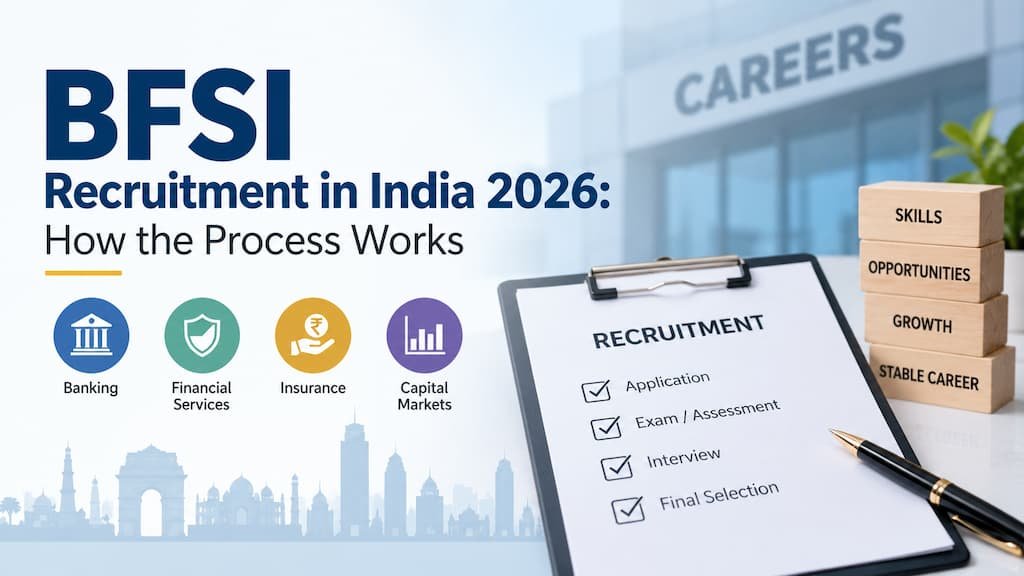
59,752. That is the number of active BFSI job vacancies on Naukri on a single day in July 2026. And yet the most common complaint from BFSI job seekers is that they cannot get interviews.
The gap between available BFSI jobs and people who successfully land them is not a skills problem. It is a process problem. Most candidates apply without understanding how BFSI recruitment actually works which means they prepare for the wrong things, apply to the wrong stage, and get rejected for reasons that had nothing to do with their ability.
This article explains the BFSI recruitment process in India from the inside. Public sector banks, private banks, NBFCs, insurance companies each runs a different process with different filters at different stages. Knowing which process you are entering, and where most candidates are eliminated, is the preparation most people skip.
Why BFSI recruitment is more process-driven than most sectors
BFSI is regulated. Every person who joins a bank, NBFC or insurance company eventually handles customer money, customer data or customer trust in some form. That regulatory reality makes BFSI employers significantly more process-driven in recruitment than, say, a consumer goods company or an IT services firm.
What that means practically: background verification is stricter. Document requirements are higher. The gap between offer letter and joining date is longer. And the reasons for rejection are sometimes things that have nothing to do with the interview like a discrepancy in a previous employment certificate or a mismatch between the address on your Aadhaar and your current residence.
Knowing this before you start saves weeks of confusion after you think you have already cleared the hard part.
The three BFSI recruitment tracks and how they differ
Before getting into the process stages, it helps to understand that BFSI recruitment in India runs on three fundamentally different tracks. Applying to a public sector bank is not the same activity as applying to a private bank, which is not the same as applying to an insurance company. The timelines, selection criteria and rejection points are all different.
| Dimension | Public Sector Banks (IBPS/SBI) | Private Banks and NBFCs | Insurance Companies |
| Entry route | Competitive exam (IBPS PO, IBPS Clerk, SBI PO, RBI Grade B) | Direct application, campus placement, referral | Direct application, agency model, campus placement |
| Selection stages | Prelims exam, Mains exam, Interview (3 stages minimum) | Aptitude test, Group Discussion, Interview (varies by employer) | Written test or GD, Interview, Medical (for some roles) |
| Time from application to joining | 8 to 14 months (exam to joining) | 3 to 8 weeks (application to joining) | 2 to 6 weeks (application to joining) |
| Background verification intensity | High government-grade document checks | High especially for credit and compliance roles | Moderate to high especially for agent licensing |
| Rejection most commonly happens at | Prelims cutoff, Mains sectional cutoff, document verification | Aptitude test, HR interview, background verification | Interview, IRDAI licensing exam, medical (life insurance) |
| Fresher friendliness | High designed for freshers with specific eligibility criteria | High most private banks run structured fresher programs | Very high insurance actively recruits freshers for sales roles |
| Salary on joining | Rs 4.5 to 9.5 lakh all-inclusive (IBA 7th Bipartite Settlement 2022) | Rs 3.5 to 7 lakh CTC depending on role and bank | Rs 2.5 to 5 lakh fixed plus variable for sales roles |
Public sector BFSI recruitment: what the IBPS process actually looks like
The IBPS PO 2026 recruitment cycle has 7,365 vacancies across 11 public sector banks. The IBPS Clerk 2026 recruitment has 11,403 vacancies. Combined, that is nearly 19,000 openings through IBPS alone and both notification windows close before August 2026.
Here is what the process looks like stage by stage, including the specific point where most candidates are eliminated.
Stage 1: Preliminary exam where 80 to 90 percent are eliminated
The IBPS PO Prelims is a 1-hour online test with 100 questions across three sections: English Language (30 questions), Quantitative Aptitude (35 questions) and Reasoning Ability (35 questions). Each section has a separate cutoff. Clearing the overall score is not enough you must clear each section individually.
This sectional cutoff is where most first-attempt candidates fail. A candidate who scores 85 out of 100 overall but gets 7 in the English section (when the cutoff is 8) is eliminated despite a strong overall performance. The sectional cutoffs are not published in advance they are set post-exam based on the performance of all candidates in that recruitment cycle.
Preparation implication: you cannot afford a weak section. One genuinely weak area ends the attempt regardless of strength elsewhere.
Stage 2: Mains exam where depth of financial awareness matters
The IBPS PO Mains is significantly harder than Prelims and includes a Data Analysis and Interpretation section that requires working with financial datasets under time pressure. The General Economy and Banking Awareness section tests knowledge of RBI policy, recent regulatory changes, current banking news and specific financial terms.
Most candidates who clear Prelims under-prepare for Banking Awareness in Mains. The questions are not generic GK they are specific. RBI repo rate on a specific date, the full form of a banking acronym used in a recent circular, the name of a scheme launched in the last quarter. A candidate who studies from six-month-old material will get these wrong.
From Our Research
One consistent pattern in IBPS Mains results: candidates who follow the RBI monetary policy calendar and read the RBI’s official press release for each MPC meeting outperform those who rely on coaching material alone for the Banking Awareness section. The MPC meets six times a year. Reading the official press release after each meeting takes 15 minutes and covers more ground than most Banking Awareness chapters in standard preparation books.
Stage 3: Interview where document problems end offers
The IBPS interview is the final stage and the stage where many candidates are eliminated not because of poor interview performance but because of document issues discovered during verification. The most common problems: certificate dates that do not match application form data, gaps in employment history that were not declared, educational certificates that list a different name than the government ID.
Before the interview: verify every document you submitted in the original application against the physical originals. Any mismatch, even a minor one like a name abbreviation, should be proactively declared and explained rather than discovered by the verification team.
Private bank and NBFC recruitment: faster but different filters
Private BFSI recruitment does not require a competitive exam. It runs on direct applications through Naukri, LinkedIn, campus placement drives and internal referrals. The process is faster 3 to 8 weeks from application to offer letter is typical for fresher roles at private banks and NBFCs.
But faster does not mean easier. The filters are different, not lighter.
The aptitude test: where most online applications end
Most private banks and large NBFCs use an online aptitude test as the first filter for walk-in and online applications. HDFC Bank, ICICI Bank, Kotak, Bajaj Finance and Axis Bank all use variants of this. The test typically covers numerical reasoning, verbal ability and basic financial awareness. Candidates who have never practised timed aptitude tests underestimate how much the time pressure affects performance.
Practical preparation: complete at least 5 full-length timed aptitude practice tests before any private bank application. The content is not hard the time management is. A candidate who can answer 70 percent of questions correctly but runs out of time will score lower than a candidate who answers 60 percent correctly with full time management.
The Group Discussion: what private banks are actually testing
Group discussions are used by HDFC Bank, Axis Bank and several large NBFCs for fresher batch hiring. The topic is typically a current financial issue a recent RBI policy decision, a sector trend, a regulatory development. The bank is not testing whether you know the right answer. It is testing whether you can communicate a financial concept clearly, listen to others without interrupting, and build on someone else’s point rather than just waiting for your turn to speak.
The most common GD mistake: speaking too early and too much. Candidates who dominate the first two minutes and then run out of substance consistently lose to candidates who speak less but say something specific and well-reasoned when they do.
The HR interview: the questions that eliminate freshers
Private bank HR interviews for freshers have a predictable set of questions that eliminate unprepared candidates quickly. Three questions that end more interviews than any others:
“What do you know about our products?” A candidate who cannot name two financial products the bank offers to retail customers and explain what they do has not done basic preparation. Check the bank website. Know two products before walking in.
“What is the current repo rate?” This is a basic financial awareness question asked at almost every private bank interview. The RBI sets the repo rate at each MPC meeting. As of June 2026, the RBI repo rate is 5.75%. Not knowing this in a banking interview signals a lack of genuine interest in the sector.
“Where do you see yourself in 3 years?” The wrong answer is a generic career aspiration. The right answer names a specific BFSI role and explains why this bank’s specific structure gives you a realistic path to it.
Insurance recruitment: the process most guides skip entirely
Insurance is the most accessible entry point into BFSI for freshers with no prior financial background. IRDAI data shows the insurance sector directly employs over 3 lakh people in India, with the agency and distribution force exceeding 25 lakh licensed agents.
Insurance recruitment splits into two distinct tracks that operate completely differently.
Track 1: Salaried roles at insurance companies
Life insurance companies (LIC, HDFC Life, ICICI Prudential Life, SBI Life), general insurers (New India Assurance, ICICI Lombard, Bajaj Allianz) and health insurers all run structured campus and direct recruitment for underwriting, operations, claims, actuarial and sales management roles. The process is similar to private bank recruitment: online application, aptitude test, interview. The differentiator for insurance roles is domain knowledge a candidate who knows the difference between term insurance and ULIP, understands what a claim settlement ratio means and can explain how IRDAI regulates solvency norms will stand out in any insurance company interview.
Track 2: Agency and development manager roles
The agency track is fundamentally different. An insurance agent is not a salaried employee they are a licensed distributor of insurance products. The IC-38 certification exam, administered by IRDAI-approved institutions, is mandatory before an agent can legally sell any insurance product. The exam costs Rs 180 and covers insurance principles, products and regulatory framework. Passing it is straightforward for a prepared candidate.
Development Manager (DM) roles at insurance companies are salaried positions that manage a team of agents. DMs are typically recruited from candidates who have 1 to 2 years of sales experience, though some insurers run fresh DM programs. A DM at a life insurance company earns Rs 3 to 6 lakh fixed plus performance incentives linked to the premium volume their agent team generates.
The background verification stage: what most guides do not tell you
Background verification in BFSI is more thorough than in most other sectors and it happens after the offer letter, not before. This catches candidates off guard. The offer feels like the finish line. It is not.
BFSI BGV typically covers: educational qualifications (degree certificates, marksheets), previous employment (offer letters, relieving letters, salary slips), criminal record check (CIBIL for banking roles, police verification for some public sector roles), address verification and identity verification against Aadhaar and PAN.
Three things that fail BGV most often in BFSI recruitment:
First, undeclared gaps. A 6-month gap between college and first job that was not mentioned in the application creates a flag. Declared and explained gaps rarely cause problems. Undiscovered gaps discovered by the BGV team almost always do.
Second, missing relieving letters. Candidates who left previous employers without following the formal exit process may not have a relieving letter. BFSI companies typically require this. Sort this before your BGV stage begins contact the previous employer’s HR and initiate the process.
Third, CIBIL score for credit-sensitive roles. Credit analysts, loan officers and risk roles at banks and NBFCs may check the candidate’s own CIBIL score during BGV. A score below 650 can be a flag for roles where the candidate will assess other people’s creditworthiness. Check your own CIBIL score before applying for these roles.
How to prepare for BFSI recruitment: the honest timeline
The “6 months of preparation” advice that appears on every BFSI coaching website is specifically for IBPS PO, not for private sector BFSI recruitment. Here is the honest timeline for each track.
| Track | Realistic Preparation Time | What to Focus On | Where Most Time Is Wasted |
| IBPS PO / Clerk | 8 to 14 months for a serious first attempt | Quantitative aptitude (daily practice), Reasoning (pattern recognition), Banking Awareness (RBI updates, scheme names, current affairs) | Generic GK instead of banking-specific awareness; ignoring sectional cutoffs in mock tests |
| SBI PO | 10 to 16 months | Higher difficulty quantitative, essay writing for Mains, financial awareness depth | Treating SBI PO preparation as identical to IBPS PO the difficulty curve is steeper |
| Private bank (fresher batch) | 4 to 8 weeks | Aptitude test practice (timed), product knowledge of target bank, current RBI policy, basic BFSI vocabulary | Over-preparing for technical finance questions when HR and communication are the actual filters |
| NBFC credit or operations role | 2 to 4 weeks | Credit fundamentals (NPA, LTV, FOIR), NBFC regulatory framework, Excel for operations roles | Applying without understanding what the specific NBFC does lender type matters for interview preparation |
| Insurance salaried role | 2 to 4 weeks | Insurance product types, IRDAI structure, claim settlement ratio, solvency ratio meaning | Not knowing the difference between life, health and general insurance products a common gap in non-insurance candidates |
| Insurance agency / DM role | 2 to 3 weeks for IC-38 | IC-38 exam preparation, understanding commission structure, building initial prospect network | Starting without completing IC-38 first legally cannot sell without it |
What to do this week if you are actively looking for a BFSI job
The IBPS PO 2026 application window closes on 26 July 2026. If you want public sector banking, that deadline is this week. Go to ibps.in, confirm your eligibility against the notification, and complete the application today. Not next week.
If private sector BFSI is your target, open your Naukri profile right now and search for relationship manager, credit officer or operations executive at the three banks you would most want to work at. Set a job alert. Apply to any active opening. The private sector process is fast a live application today can result in an aptitude test invite within 5 days at large private banks that recruit continuously.
One thing to do before either application: check the current RBI repo rate on rbi.org.in and note it down. You will be asked this question. You should already know the answer.
Related Reading on BFSIBlogs
- What is BFSI?
- BFSI Companies in India: Complete List
- Why BFSI Sector? 7 Honest Reasons to Choose It in 2026
Sources and References
1. IBPS Official Website PO 2026 and Clerk 2026 Vacancy Notifications: ibps.in
2. Taggd India Decoding Jobs Report 2026 BFSI Hiring Intent and Growth Projections: taggd.in
3. IRDAI Annual Report 2023-24 Insurance Sector Employment Data: irdai.gov.in
4. IBA 7th Bipartite Settlement 2022 Public Sector Bank Starting Salary Structure: iba.org.in
5. Naukri.com Active BFSI Job Vacancy Count, July 2026: naukri.com
6. RBI Monetary Policy Statement, June 2026 Current Repo Rate: rbi.org.in
FAQs About BFSI Recruitment
Yes, and most serious BFSI job seekers do this. Private bank recruitment runs on a different timeline and process from IBPS. There is no conflict. Many candidates who eventually clear IBPS entered BFSI through a private bank role first and prepared for the public sector exam while working. This is a legitimate and common strategy.
Most BFSI employers do not publish a minimum CIBIL score threshold. In practice, scores below 650 create flags for credit-sensitive roles (credit analyst, loan officer, risk management). For operations, HR, technology and non-credit roles, CIBIL scores are typically not checked. Check your own score before applying for any credit-facing BFSI role and address any negative items proactively.
Typically 2 to 4 weeks for private BFSI employers. Public sector joining after IBPS can take 2 to 3 months from final merit list to actual joining date. Prepare all documents educational certificates, relieving letters from previous employers, address proof, PAN, Aadhaar before the offer letter stage so the BGV process does not delay your joining.

